

When I raised my camera for the first time on the Mediterranean island of _Alba: A Wildlife Adventure_ and aimed at the injured white stork, the six-year-old Alba stood on tiptoe suddenly reminded me of the natural observation note that I was always dissatisfied with my childhood. This seemingly simple children’s game reconstructs the poetic connection between man and nature in the purest way.
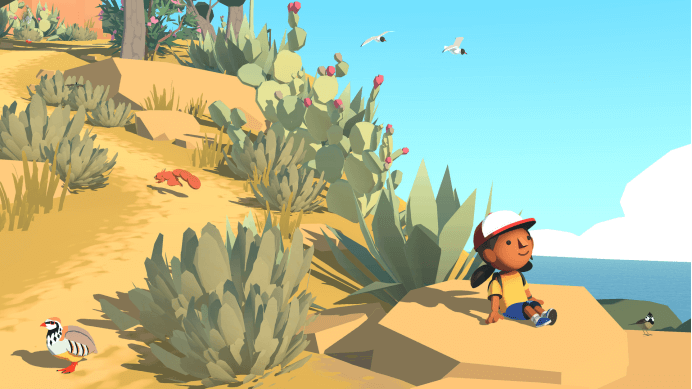
The game starts in the early morning of the summer vacation. Alba came to the Mediterranean to visit his grandparents, but found that his beloved nature reserve was under threat of development. But what really makes this adventure magical is its accurate restoration of the child’s perspective — when adults discuss municipal meetings and development plans, Alba and his friends are calculating how many signatures are needed to save the fox’s home. When the mayor said, “Ecological protection can’t be eaten as a meal”, Alba raised the camera and asked, “Then why does Grandma White Stork fly thousands of miles back here for dinner every year?”
The most moving struggle took place in the “Civic Science” action. Alba and I need to photograph and record the survival of all the wild animals on the island. This seemingly game-like task is actually an excellent class to show children the power of citizens. When we find endangered lynx cubs in the abandoned factory, record migrating water birds at the resort site, and rescue injured wild boars by the garbage heap, the figure of each child holding a camera has become the most powerful environmental declaration.
The game’s interpretation of “childhood power” is exciting. Alba’s petition gradually converged from being alone at the beginning to a collective movement of the whole community — at first, the indifferent fishermen helped to record the traces of whales, once rejected the environmentally friendly hotel managers to provide drone support, and even the mayor who initially opposed it eventually became the co-builders of the protected area. The most exciting thing was that at the city hall hearing, when the adults were in an argument, Alba directly played the “testimony” of the wild animals — the moments of life recorded by those cameras were more convincing than any data.
With the expansion of protected areas, I found that the game mechanism itself is a perfect carrier for ecological education. When using the camera, you need to keep a safe distance. To record species, you need to accurately observe the characteristics, and even the garbage needs to be sorted and recycled. Once after I rescued a turtle trapped in plastic on the beach, the game popped up real data: “More than one million marine creatures die from plastic garbage every year” — at this moment, the virtual and reality have a deep connection.
At dusk after customs clearance, I took my neighbor’s child to the city park. The most precious legacy of this game is that it allows me to regain the ability to observe the world with childlike curiosity. If you also want to find the original touch in the impetuous era, _Alba: A Wildlife Adventure_ will give you the purest gift. It won’t preach, but it will make you understand in Alba’s camera lens: you don’t need a grand oath to protect nature, you just need to keep the excitement when you first saw the rainbow.