

When I checked my lease contract for the first time in the dilapidated medical cabin of The Eye space station and looked at the countdown to remind me that my body would automatically shut down in 97 cycles, I suddenly understood what “selling myself as a slave” was in the digital age. _Citizen Sleeper_ tells a modern allegory about physical ownership and spiritual freedom with the most poetic cyberpunk narrative.
The game opens in the aftermath of consciousness upload. The “sleeper” I played — a corporate slave who implanted consciousness into the rented Cyborg body, escaped to this outlawed space station. But what really makes this game hit people’s hearts is not its science fiction shell, but its sharpest metaphor for contemporary life: the first thing to do when you wake up every day is to check the “physical stability” index, just like modern people check the power of their mobile phones; you need to use credit points to buy inhibitors to prevent the body from being remotely recovered by the original company, just like reality. We pay various subscription fees to maintain digital identity; even “hunger”, “tired” and “pain” have become resources that need to be managed. In this world, even having a hungry and painful body has become a privilege that needs to be fought for desperately.
The most shocking narrative takes place in the encounter with the engineer “Angel”. This paralyzed old man modified my body so that I could move freely in the abnormal gravity area of the space station, but every transformation required me to make a cruel choice: whether to enhance my athletic ability but accelerate my physical decline, or to maintain the status quo but give up exploring key areas? Remember that in the “The Greenway” mission line, I need to save enough credit points to buy a real apple seedling without taking inhibitors for ten consecutive days — which means that I have to risk my body being withdrawn by the company at any time in exchange for a “beauty” that is useless to Cyborg’s body. When I finally planted the seedlings in the abandoned airlock compartment and watched it grow its first bud, I suddenly shed tears in front of the screen — it turned out that the desire for “useless beauty” was the final line between us and tools.
With the establishment of a fragile network of people in the space station, I discovered the most gentle paradox in this dystopia: the most dilapidated places often have the most solid connection. In The Eye bar, the bartender Feng who always left me the last glass of synthetic wine taught me that the real freedom is not what to have, but what can be given; in The Docks, the wanderer Lem made a “birthday gift” for me with the parts he picked up — a useless function but will randomly play the earth. Bird’s audio chip; even the black market merchant Min, who originally only wanted to take advantage of me, will secretly give me an emergency inhibitor before the contract expires. These relationships are not task rewards, but you actively choose to water the flowers of life with the little remaining “energy value” in the gap between managing physical resources.
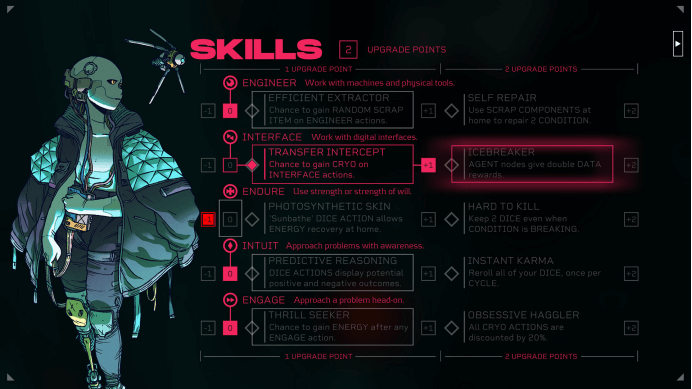
The most profound system design of the game lies in how it transforms the “body” into a narrative engine. Your every action — reading, repairing, talking and even being in a daze — will consume the body state value, and the loss of different body modules will trigger different memory flashbacks and plot branches. Once my “nerve interface” was seriously damaged, and the game screen suddenly turned into a distorted fault art, and the memory fragments of the original body owner sounded in my ears: a vague dream about the earth’s ocean. At that moment, I realized that there were countless former users’ memory geological layers deposited in this rented body.
Late at night after customs clearance, I touched my warm wrist. The most lasting magic of _Citizen Sleeper_ is that it allows players to feel the most basic reality of “having a body” again. In this era when digital identities can be copied and sold at will, perhaps the biggest resistance is to remember that there will be hunger, pain and fatigue, which is the proof that we are born to be human. If you are also looking for contemporary answers about belonging, this game will give you the most gentle revelation — home is never somewhere, but those life connections that make you willing to risk protecting with the rented body.