

When I first picked up the feather pen in the Kiersau Abbey in the 16th century and watched the ink faint on the parchment, I suddenly realized that this was no longer a detective game, but a heavy trial about “who has the right to write history”. In the most gentle way, Obsidian Entertainment re-sewed the voices of ordinary people who were crushed under the wheels of history during the Reformation into the parchment paper of time.
The story opens in the town of Tassing in 1518. The illustrator I played, Andreas Maler, was entrusted to draw manuscripts for the monastery, but was involved in a series of bizarre deaths. But what really makes _Pentiment_ stand out is not the murder mystery itself, but how it weaves the social tension of the whole 16th century Europe into the investigation process — every questioning of a peasant woman may trigger a fierce debate about tithes; every page of church archives revealed Latin The suppression of local dialects by hegemony; and even the choice of what to eat for lunch can involve the economic war between Jewish butchers and Christian butchers.
The most shocking narrative takes place in the time jump in the second chapter. When I returned to Tassing as a middle-aged Andreas Maler, I found that the clever printer’s daughter 20 years ago had now become a silent nun; the young farmer who once rebelled against the lord was preaching in the same domineering way after becoming a Protestant priest. The game does not make a direct judgment, but only calmly shows that when the wheels of history run over, even the rebels may become new oppressors. I remember that when investigating a land dispute, I needed to consult three records of Latin contracts, German testimony and local agricultural proverbs at the same time, and found that each version was telling a different “truth” — at that moment, I understood that history is never a collection of facts, but a struggle for narrative rights.
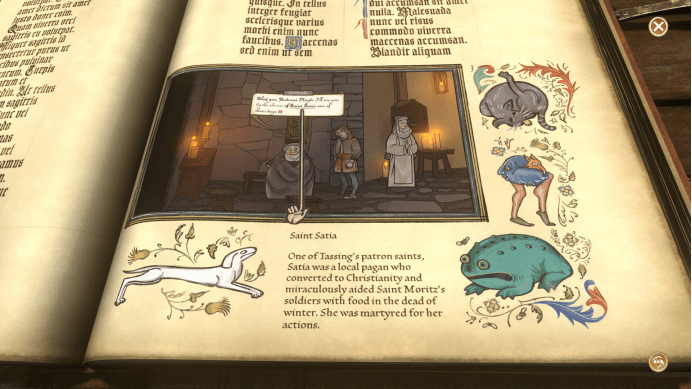
With the deepening of the investigation, the hand-drawn aesthetics of the game has become the most powerful narrative tool. When Andreas is emotional, the picture will degenerate from the exquisite Renaissance style to childlike graffiti; when he studies ancient books, the texture of the parchment and the traces of insects are clearly visible; the best thing is the text animation when the characters talk — the nobles circle elegantly in Gothic, and the peasants jump clumsily in bold. , and the words of Jewish merchants are always bound by the border. These visual details silently tell the strict social hierarchy of the 16th century.
The most profound question of the game appears in the final chapter. When Andreas finally uncovers the decades-long truth, players need to make a choice: whether to make the truth public and destroy the belief of the whole community, or to weave a well-intentioned lie to keep history asleep? I stared at these two options in silence for fifteen minutes, and finally chose to take the secret to the grave — not because of cowardice, but because I finally understood the greatest ethical dilemma of historians: sometimes the harm caused by exposing the truth is more cruel than the lie itself.
Late at night after customs clearance, I turned over the real history of the Reformation. Those once boring years and treaties suddenly became warm, because I “met” the laundry woman who was burned to death because of a vernacular Bible, and “know” the scribe who was struggling between Latin and German. This may be the greatest achievement of _Pentiment_: it makes the ink of 400 years ago have a heartbeat again.
If you also want to experience the temperature and weight of history, _Pentiment_ will give you the most profound empathetic education. It won’t give you a heroic epic, it will only show you the fingerprints covered by ink on the back of the parchment — after all, it’s not just the Pope and the king, and those ordinary people who don’t even leave their names that really change the world.