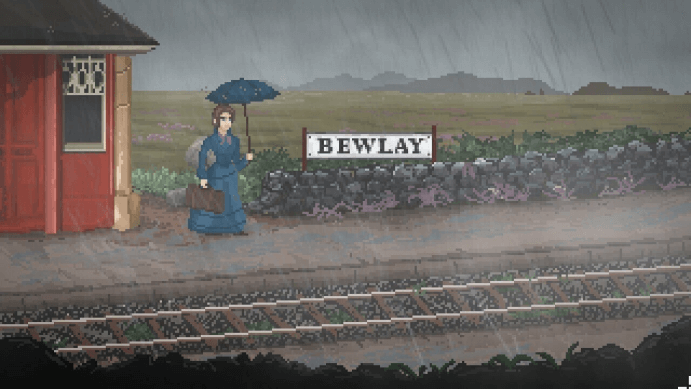


When I first stepped into the dense forest called “Moria Peninsula” as Roadwarden, there was no picture on the screen, only a few lines describing the humid air, the touch of the ferns underfoot, and the chirping of crows in the distance — right there For a moment, a vast territory than any open world was quietly generated in my mind. _Roadwarden_, a pure text RPG from Poland, completed the most avant-garde narrative revolution in the most classical way.
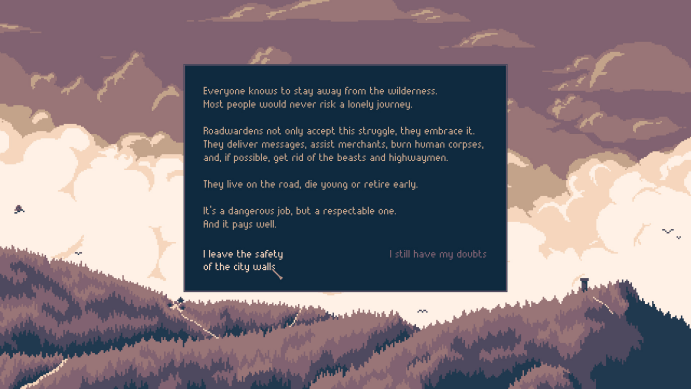
The game opens with the letter of appointment of the Merchants’ Guild. I played the role of a Roadwarden who was hired to explore the unexplored peninsula. The task was to record everything here in words. But what really makes this game magical is not the story it tells, but the way it refuses to tell — when I find an abandoned shrine in the forest, the game will not directly tell me what happened here, but give seven observation angles: the degree of weathering of the stone, the type of stains on the altar, and the surrounding plants. Abnormal growth... Each choice will lead to different narrative branches. I remember that when I first encountered the robber camp, I chose “Observe the embers’ temperature” instead of “Check the discarded weapons”, and the conclusion was that they had just left. , thus avoiding a head-on conflict. This design of “observation” itself as the core gameplay makes every player a real detective.
The most shocking experience happened in the chapter “Foggy Fen”. I need to draw a map of the swamp through four descriptions of different villagers, and each description is full of contradictions — the old hunter “Old Huntsman” insists that there is a reliable path in the west, but the shepherd girl “Shepherd Girl” says that it is “Man-eating Pitcher Plant territory”; The woodcutter “Woodcutter” warned not to enter on the night of the full moon, while the herbalist “Herbalist” said that only then could the life-saving moss “Goldenmoss” be picked. There is no map interface, no task mark, and I can only keep repainting on a piece of self-made draft paper. In the end, what I draw is not the geographical terrain, but the interpersonal relationship and trust network of the whole community. When I finally crossed the swamp on the seventh day, I suddenly understood the true meaning of the game: what we explore is never the land, but the prejudices and memories in people’s hearts.
With the change of seasons, the game shows the unique time magic of words. The same place, in the “Early Frost” chapter is “a muddy path covered in thin ice”, and when it comes to “Snowmelt”, it becomes “a bubbling black m Ire”; The same NPC, “Harvest Moon” will generously share food during the harvest season, and “Hunger Moon” may sell you for a piece of dried meat in the famine month. The most exquisite thing is the use of “silence” in the game — sometimes in the face of key choices, the game will provide the option of “Say nothing”, and the next paragraph will produce a completely different rhythm because of your silence. Once in the village gathering “Village Gathering”, I chose to remain silent three times in a row, and finally waited for an elder who was originally hostile to me to take the initiative to reveal the truth. This deep understanding of the power of language makes every dialogue a psychological game.
The greatest creation of the game is how it transforms reading behavior into a spatial experience. When you select “Head north” continuously, the paragraph will gradually become shorter, with fewer adjectives and more verbs, simulating the fatigue of a long journey; when you stay in a certain place to investigate “Investigate the site”, the text will suddenly become delicate. Come on, there are details that are usually ignored: the marching route of ants, the marks on the bark, and the looming smell in the wind. This environmental shaping based on the rhythm of reading is more immersive than any 3D modeling. During the game late one night, I even had a hallucination — I was sitting in the air-conditioned room, but it seemed that I really smelled the “mixed scent of humus and wild mint” described in the article.
In the early morning after customs clearance, I walked on the hiking trail I often go to. The most enduring gift of _Roadwarden_ is that it reshapes the way I observe reality. Now every forest seems to have a hidden story, every rut may be a clue, and even the expressions of strangers have become interpretable texts. If you also want to rediscover the original magic of the world of writing, this work will give you the most profound inspiration — after all, the vastest open world is never in the graphics card, but in the imagination of everyone who is willing to read it carefully.