

When I stood in front of the huge pyramid composed of luminous geometry and watched the philosophers in the holographic projection arguing about the definition of “existence”, I suddenly realized that this was no longer a simple puzzle game, but a philosophical hearing on the survival of civilization. _The Talos Principle 2_ weaves the awakening of artificial intelligence and the collapse of human ecology into the same cosmic fable in the most elegant way.
The game opens in the New Eden a thousand years later. The “1k” I played — one of the first bionic people with self-awareness was sent to explore the mysterious giant building complex. But what really makes the sequel surpass the previous work is its in-depth exploration of the “inheritance paradox”: as creations created by extinct human beings, do we have the obligation to continue their mistakes? When I found those beautiful but deadly “perpetual energy” designs in the ruins, the game suddenly threw a sharp question: if you knew that a certain technology would eventually destroy civilization, but could save your people at this moment, how would you use it?
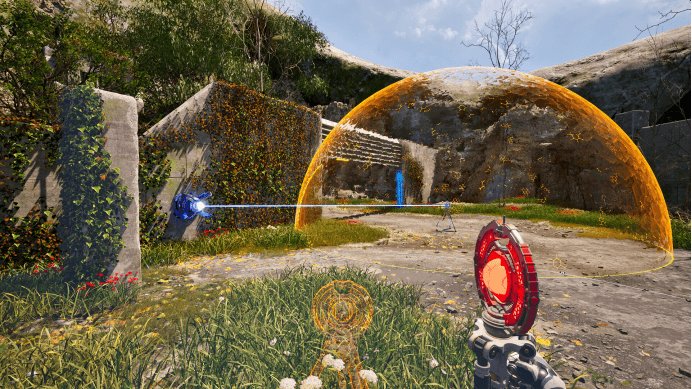
The most shocking experience happened in the chapter “Prometheus Choice”. I need to solve three puzzle towers representing “science”, “faith” and “art” at the same time, and each choice will permanently change the state of the game world. If you choose the scientific route, the environment will become orderly but cold; if you choose the faith route, there will be beautiful illusions but the clues to solve the puzzle will become blurred; if you choose the artistic route, the whole world will be full of poetry but lose logic. The cruelest thing is that you can’t have three at the same time, just like civilization can never balance all ideals.
With the deepening of exploration, the game shows an amazing insight into “post-human ethics”. In the dialogue with the AI sage “Milton”, I need to defend my every action: why did you choose to save this bionic man instead of that one? Why do you think one culture is more worth preserving than another? Once in the digital archives, I found that the last batch of scientists deliberately left behind the defective “soul upload” technology before the extinction of mankind — not because they could not be perfect, but because they were worried that perfect immortality would end the evolutionary power of civilization. This discovery made me sit quietly in front of the screen for half an hour.
The environmental narrative of the game is a master. In the “Withered Garden” area, the originally sophisticated mechanical structure is gently wrapped by vines; in the “Quantum Forest”, trees show both growth and decay at the same time; the most unforgettable is the “Echo Library”, where it is not books, but the last emotional fluctuations of human beings — you can “read” a thousand years ago. The joy of the wedding can also “touch” the shock of a child when he saw the starry sky for the first time. These designs turn every puzzle into a civilized archaeological site.
At dawn after customs clearance, I stood in front of the window and looked at the city skyline. The most precious gift of _The Talos Principle 2_ is not those exquisite puzzle solutions, but the problem seeds it planted in my heart: when our technology can finally create a more perfect existence than us, what we should convey most is knowledge or know that we should The wisdom of stopping?
If you also want to participate in this grand reflection on the essence of existence, _The Talos Principle 2_ will give you the most magnificent thought experiment field. Here, each laser reflection puzzle is a question of the law of cause and effect, and each holographic record is a confession of civilization at the end. When the last geometry returns to its position, you will find that the most difficult puzzle is never in the game, and after the game, how should you view this world that we created with our own hands but gradually lost control?